

The Composition and Grades of Stainless Steel
The most commonly used grade for countertops is Type 304 stainless steel. This grade is an austenitic chromium-nickel alloy containing at least 18% chromium and 8% nickel, which provides excellent corrosion resistance and durability.
Another important grade is Type 316 stainless steel, which includes 2-3% molybdenum for enhanced corrosion resistance, particularly against chlorides and industrial solvents. While more expensive, it’s suitable for environments requiring higher resistance to chemicals and salts.
This composition gives stainless steel some unique properties, making restaurant stainless steel countertops a top-notch option.
- Corrosion resistance
- High Tensile Strength
- Durability
- Require low-maintenance
- Environment friendly
Choosing the right grade of stainless steel ensures the longevity and functionality of your kitchen countertops, with Type 304 being the most versatile and widely used option.

Comparison Of Stainless Steel Countertops with Other Materials
Let’s compare stainless steel countertops with granite, quartz, and wood to understand why stainless steel is a superior choice for professional kitchens.
| Factors | Stainless Steel | Quartz | Granite | Wood |
|---|---|---|---|---|
| Cost | High | Medium | Medium | Low |
| Durability | High | High | High | Low |
| Resistance | High | Medium | Medium | Low |
| Maintenance | Low | High | High | Very High |
While granite and quartz offer durability, they require high maintenance. Granite, for example, absorbs liquids and requires periodic sealing, whereas stainless steel is nonporous and needs no additional maintenance. Quartz countertops are not heat-resistant, requiring heat protection to prevent damage, unlike stainless steel, which can withstand high temperatures.


Wooden countertops, while aesthetically pleasing, are high-maintenance and less resistant to wear and tear. They need to be replaced frequently due to susceptibility to bacterial growth, making them less hygienic.
Two Types of Stainless Steel Countertops
The two widely-used stainless steel countertops are composite stainless steel and solid stainless steel. Among them, the anti-scratch solid stainless steel countertop has been particularly popular in the recent two years.
Stainless Steel Composite Countertop
A composite stainless steel countertop consists of three layers: a stainless steel sheet on the front, a filler in the middle, and a bottom galvanized steel sheet. The filler typically includes multi-layer boards, PVC, or an aluminum honeycomb core. From an environmental perspective, we recommend using the aluminum honeycomb core.


Advantages:
Cost-effective and widely used in both home and commercial kitchens.


Disadvantages:
- Requires glue to bond the middle filler
- Cannot be produced in one piece; gaps at the corners need to be welded and polished during installation
Solid Stainless Steel Countertop
Popular thicknesses include 5mm, 6mm, 8mm, 10mm, and even 20mm.


Advantages:
- Durability: Produced from a single sheet without welding, contributing to its current popularity.
- Environmental Friendliness: No middle fillers and no glue.
- User-Friendliness: The full edge can be polished to smooth rounded corners, which is safer for the elderly and children.


Disadvantages:
Higher cost compared to composite countertops.
Choosing the Thickness of the Front Panel for Stainless Steel Composite Countertops
The common thickness of the front panel varies according to different uses, generally ranging from 0.8mm to 3mm. The selection should be based on the actual situation.
1. For Home Kitchens: Stainless steel sheets with a thickness of 0.8mm to 1.5mm are generally used. Thinner sheets are easier to process and install but are prone to stress and deformation. Thicker sheets are more durable but harder and more costly to work with.
2. For Commercial Kitchens: The thickness typically ranges from 1.5mm to 3mm. The harsh working environment of commercial kitchens demands stronger and more durable stainless steel countertops.
What are the Types of Finishes Used in Stainless Steel Composite Countertops?
Different finishes can offer unique visual appeal, enhance certain properties, and even hide imperfections. Here, we explore four popular finishes used in stainless steel composite countertops:
Hairline / Satin
The hairline and satin finish, features fine brushed lines onto the surface of the stainless steel. This creates a smooth, matte appearance that is less reflective than polished finishes.



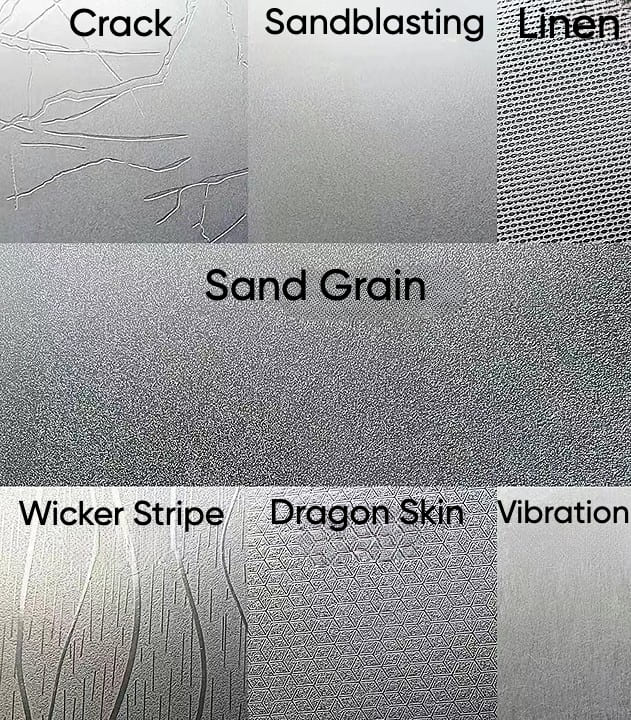
Vibration
The vibration finish is created by applying a random, non-directional pattern to the stainless steel surface. This results in a distinctive, swirled appearance that diffuses light and minimizes glare.

Sandblasted
The sandblasted finish is achieved by using high-pressure air to blast abrasive particles at the surface, creating a uniform, matte texture. This process gives the surface a slightly rough, frosted appearance.

Embossed
Embossing involve pressing patterns into the stainless steel surface, creating a raised or recessed design. Two popular patterns for countertops are linen and sand grain.

Anti-Fingerprint (AFP)
Anti-fingerprint(AFP) coating refers to the coating of a protective layer of transparent or yellowish liquid on the surface of stainless steel.
After selecting the surface finish, we will usually apply a layer of AFP because the countertops can be prone to showing fingerprints and smudges without AFP.
Anti-Scratch
Better than the anti-fingerprint is the anti-scratch, because the processing cost is relatively expensive, we usually apply it to solid stainless steel countertops. Of course, the stainless steel composite countertop can also be anti-scratch treated if you have such requirement and enough budget.
During daily use, sometimes it is easy to scratch the countertop by a knife/something sharp or in contact with a hot pot or kettle, so we recommend you consider anti-scratch coating as no obvious marks will be left on the countertop. If scratch resistance is a key requirement for your project, read our detailed guide to anti-scratch stainless steel countertops, including the hard-coat structure, available thicknesses, compatible finishes, and solid versus composite options.
Final Thoughts
Stainless steel countertops offer a combination of durability, hygiene, and low maintenance that is hard to beat. Their resistance to heat, stains, and corrosion makes them ideal for the high demands of a professional kitchen. Additionally, the variety of finishes and the ability to choose between composite and solid stainless steel allows for customization to fit both aesthetic and functional needs.
While the initial cost may be higher compared to other materials, the long-term benefits and savings in maintenance make stainless steel a wise investment. Whether you’re outfitting a busy restaurant kitchen or a stylish home kitchen, stainless steel countertops provide a versatile and reliable solution that stands the test of time.
If you have any questions or would like to learn more about stainless steel countertops, please feel free to reach out to Vigorss team at [email protected] or call us at 0086-13715484114.
FAQ
1. Why choose stainless steel for kitchen countertops?
Stainless steel countertops are strong, heat-resistant, stain-resistant, and hygienic. The non-porous surface doesn’t absorb water, oil, or food residue, which makes cleaning easy and helps keep kitchens safe and professional-looking over many years.
2. What are the main types of stainless steel countertops?
There are two main structures:
- Thick solid stainless steel panels (for example 3–10 mm).
- Composite countertops made by laminating thin stainless steel sheets onto a core such as plywood, MDF, or aluminum honeycomb.
Both use stainless steel as the working surface but differ in weight, cost, and rigidity.
3. When should I use thick solid stainless steel countertops?
Use thick solid panels when you want a very robust, “monolithic” metal worktop. They are ideal for professional kitchens, premium residential islands, and projects where the countertop may receive strong impacts or heavy loads. Solid tops can also be re-polished after years of use to refresh the surface.
4. When are composite stainless steel countertops more suitable?
Composite tops are better when you need large sizes with lower weight and more flexible design. The thin stainless steel sheet is bonded to a core board or honeycomb, giving a rigid but lighter structure. This is useful for long counters, big islands, and projects where ease of installation and cost control are important.
5. What thickness of stainless steel is commonly used for countertops?
For solid countertops, thickness is often in the range of 3–10 mm depending on budget and design.
For composite countertops, the stainless steel surface is usually around 0.8–1.2 mm, while the core thickness can be adjusted to reach the final countertop thickness the designer wants.
6. Which stainless steel finishes are recommended for countertops?
Popular finishes include brushed (satin / hairline), vibration, sandblasted (matte), and special textures such as rock or marble-like patterns. These finishes help hide light scratches, reduce glare, and give the countertop a softer, more refined appearance than mirror-polished stainless steel.
7. What is anti-scratch stainless steel and when should I consider it?
Anti-scratch stainless steel has a special hard surface layer designed to improve scratch resistance compared with normal stainless steel. It’s a good choice for heavy-use kitchens, show kitchens, cafés, and other spaces where the countertop is used and cleaned many times a day and you want to reduce visible wear over time.
8. Can stainless steel countertops be combined with integrated sinks and backsplashes?
Yes. Many projects weld the sink, countertop, and sometimes the backsplash into a single stainless steel assembly. This creates a seamless, easy-to-clean working area without joints where dirt can accumulate. It is especially popular in professional kitchens and high-end residential designs.
9. Are stainless steel countertops noisy or “cold” to use?
Stainless steel feels cooler to the touch than wood or stone, but this is often an advantage in hot kitchens. If you are concerned about noise or a “hollow” sound, using a suitable core (plywood, MDF, or honeycomb) and proper bonding can make the countertop feel solid and reduce sound when placing cookware on it.
10. How do stainless steel countertops compare with stone or quartz?
Compared with stone or quartz, stainless steel is lighter, more hygienic, and more tolerant of heat shocks. It will not chip like stone, and it is fully recyclable. On the other hand, stainless steel is more prone to small surface scratches, which is why many designers choose brushed, matte, or textured finishes that hide fine marks.
11. How should stainless steel countertops be cleaned and maintained?
Daily cleaning is simple: use a soft cloth or sponge with mild detergent and water, then wipe dry along the grain. Avoid steel wool and very aggressive chemicals that may damage the surface. Over time, the finish will develop a uniform “patina” of micro-scratches that many users find attractive and practical.
12. What information should I prepare before asking for a quote for stainless steel countertops?
You’ll get a better quote if you confirm:
- Countertop dimensions and thickness.
- Solid vs composite structure.
- Stainless steel grade (e.g. 304 or 316, indoor vs seaside/outdoor use).
- Desired surface finish (brushed, vibration, sandblasted, patterned, anti-scratch, etc.).
- Whether you need integrated sinks, backsplashes, cut-outs, or edge details.
With these details, the Vigorss team can suggest appropriate structures and finishes and offer a more accurate price and lead time.


